G Ashik Jaman ★★★★★"Fantastic service from start to finish. They responded quickly explained the issue with my roof clearl..."G Paul Maher ★★★★★"Just had some roof works carried out by Up Top Roofing and would highly recommend them. The works incl..."G Melanie Woodall ★★★★★"Replaced a flat roof to the main house and felt garage roof. Great team. Honest evaluation of work nee..."G Keith Fernandes ★★★★★"Keiron and his team at Up Top Roofing were absolutely amazing! They came in to fix a roof that had bee..."G Lyn Hay ★★★★★"I can't thank enough Keiran, his team and ladies in the office for their patience. I must have been a..."G Bryan Dowdey ★★★★★"Up Top Roofing responded quickly to my request for a small flat lead roof to have the lead replaced wi..."G Sarah Moore ★★★★★"Brilliant...Up Top Roofing are an extremely professional & knowledgeable company. They have recently r..."
G Ashik Jaman ★★★★★"Fantastic service from start to finish. They responded quickly explained the issue with my roof clearl..."G Paul Maher ★★★★★"Just had some roof works carried out by Up Top Roofing and would highly recommend them. The works incl..."G Melanie Woodall ★★★★★"Replaced a flat roof to the main house and felt garage roof. Great team. Honest evaluation of work nee..."G Keith Fernandes ★★★★★"Keiron and his team at Up Top Roofing were absolutely amazing! They came in to fix a roof that had bee..."G Lyn Hay ★★★★★"I can't thank enough Keiran, his team and ladies in the office for their patience. I must have been a..."G Bryan Dowdey ★★★★★"Up Top Roofing responded quickly to my request for a small flat lead roof to have the lead replaced wi..."G Sarah Moore ★★★★★"Brilliant...Up Top Roofing are an extremely professional & knowledgeable company. They have recently r..."
G Ashik Jaman ★★★★★"Fantastic service from start to finish. They responded quickly explained the issue with my roof clearl..."G Paul Maher ★★★★★"Just had some roof works carried out by Up Top Roofing and would highly recommend them. The works incl..."G Melanie Woodall ★★★★★"Replaced a flat roof to the main house and felt garage roof. Great team. Honest evaluation of work nee..."G Keith Fernandes ★★★★★"Keiron and his team at Up Top Roofing were absolutely amazing! They came in to fix a roof that had bee..."G Lyn Hay ★★★★★"I can't thank enough Keiran, his team and ladies in the office for their patience. I must have been a..."G Bryan Dowdey ★★★★★"Up Top Roofing responded quickly to my request for a small flat lead roof to have the lead replaced wi..."G Sarah Moore ★★★★★"Brilliant...Up Top Roofing are an extremely professional & knowledgeable company. They have recently r..."
G Ashik Jaman ★★★★★"Fantastic service from start to finish. They responded quickly explained the issue with my roof clearl..."G Paul Maher ★★★★★"Just had some roof works carried out by Up Top Roofing and would highly recommend them. The works incl..."G Melanie Woodall ★★★★★"Replaced a flat roof to the main house and felt garage roof. Great team. Honest evaluation of work nee..."G Keith Fernandes ★★★★★"Keiron and his team at Up Top Roofing were absolutely amazing! They came in to fix a roof that had bee..."G Lyn Hay ★★★★★"I can't thank enough Keiran, his team and ladies in the office for their patience. I must have been a..."G Bryan Dowdey ★★★★★"Up Top Roofing responded quickly to my request for a small flat lead roof to have the lead replaced wi..."G Sarah Moore ★★★★★"Brilliant...Up Top Roofing are an extremely professional & knowledgeable company. They have recently r..."
Flat Roof Repair vs Replacement UK: Costs, Lifespan & Best Option in 2026
Flat Roof Repair vs Replacement UK: Costs, Lifespan & Best Option in 2026 Introduction If your flat roof is leaking, bubbling, ponding or just showing its age, the real question is not "can this be patched?" The real question is: which option gives the best outcome over the next five to fifteen years? For most [...]
Up Top Roofing
Roofing specialists
26 April 2026
Original article
10 min read
2,141 words
Introduction
If your flat roof is leaking, bubbling, ponding or just showing its age, the real question is not “can this be patched?”
The real question is: which option gives the best outcome over the next five to fifteen years?
For most UK homeowners, the honest answer is simple: repair a sound roof, replace a failing system. Homeowners lose money paying for repeated short-term fixes on roofs that already have wet insulation, failing details or poor drainage built into the structure.
This guide cuts through the noise and gives you a clear decision framework, real 2026 costs, lifespan data by system, an inspection checklist, and the regulatory rules that catch most homeowners out.
The clear answer in one paragraph
Choose repair when the leak source is identifiable, the defect is local rather than widespread, the roof build-up underneath is still dry and firm, outlets and falls are basically working, and the roof is not near end of life.
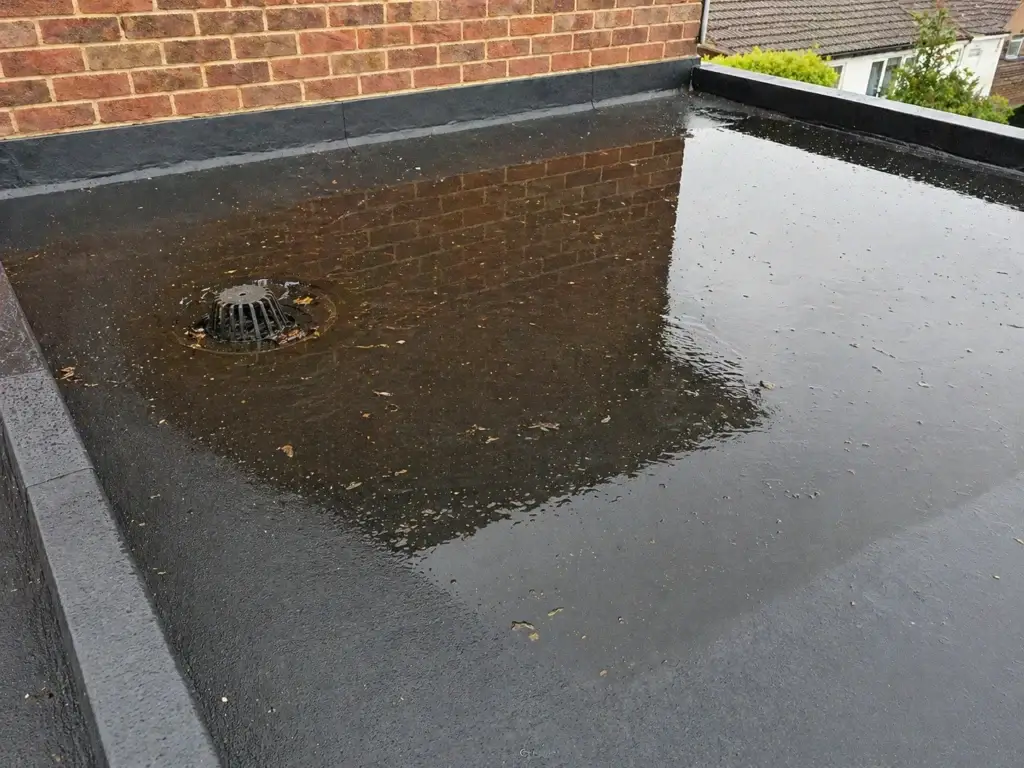
Choose replacement when you have repeated leaks, multiple failed details, widespread blistering or splitting, lifted seams, ponding caused by poor falls, soft deck, wet insulation, or a repair history that is starting to cost more than a proper renew.
In plain English: repair is a defect solution. Replacement is a system solution. If the system is fundamentally good, repair it. If the system itself is failing, replace it.
Quick comparison table
Attribute
Repair
Replacement
Upfront cost
Lower cash outlay
Higher upfront spend
Best when
Roof is mid-life and defect is local
Roof is at or near end-of-life
Disruption
Usually low
Higher, especially with deck strip
Insulation upside
Limited
Strong (current standards)
Warranty position
Often workmanship only
Full manufacturer + IBG cover
Long-term ROI
Better for isolated defects
Better for recurring failure
Urgency fit
Stops immediate ingress
Ends repeat-leak cycle
When repair is the better call
Repair is the right move in four situations:
Local damage: a puncture, a split at one detail, a failed flashing edge, a worn coating on a small area
Sound deck: no evidence of moisture spread beneath the membrane
Years left in it: the roof has not reached its expected service life
Workable drainage: the leak is not the symptom of poor falls or chronic ponding
The advantage is obvious: it protects cash flow. A competent repair on a roof with one defect can stop ingress without forcing a full renewal.
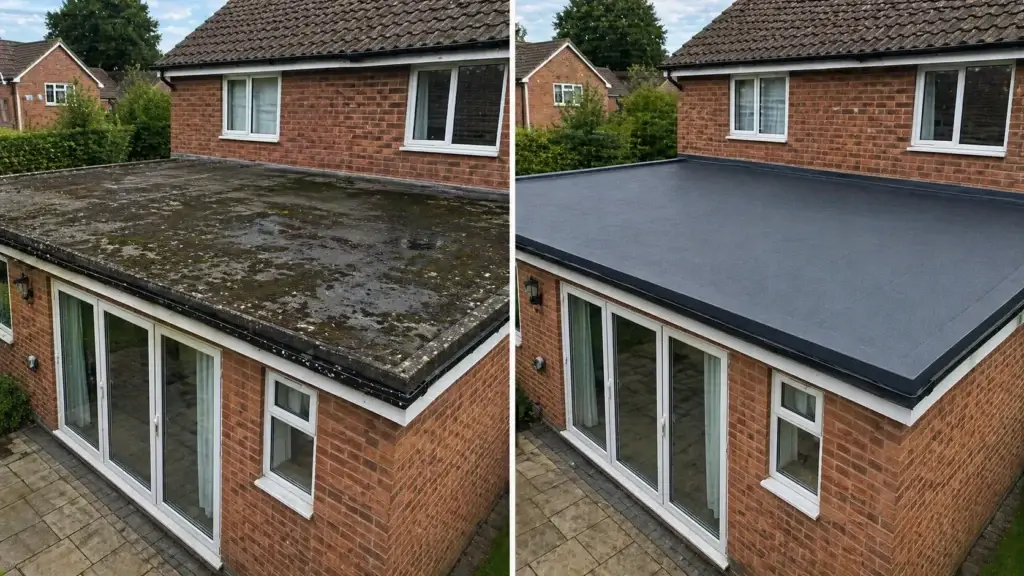
The downside is what repair does not do. A repair on a 17-year-old felt roof leaves you with a 17-year-old felt roof. If the rest of the system has hidden weak points, you’ll be calling roofers back for the next failure.
When replacement is the better call
Replacement is right when failure has gone from “one place” to “a pattern”:
Recurring leaks at multiple points
Widespread cracking, blistering or surface degradation
Historic patchwork showing through
Sagging or softness in the deck
Insulation likely waterlogged
Ponding caused by poor falls, not blocked outlets
Repair costs starting to outweigh renewal value
There is also a regulatory angle. In England, where renovation affects more than 50% of an existing roof element, Approved Document L targets an improved U-value of 0.16 W/m²K, subject to feasibility. That means a replacement project can fix the leak and upgrade thermal performance in one job.
Commercially, replacement is also where warranties get strongest. Manufacturer-approved contractor systems tie meaningful guarantees to correct specification and trained installers. Ad-hoc patching on an ageing roof simply cannot match that protection.
Flat roof lifespan by system
These ranges assume proper design, correct installation and routine inspection. Bad install kills any system, regardless of brand.
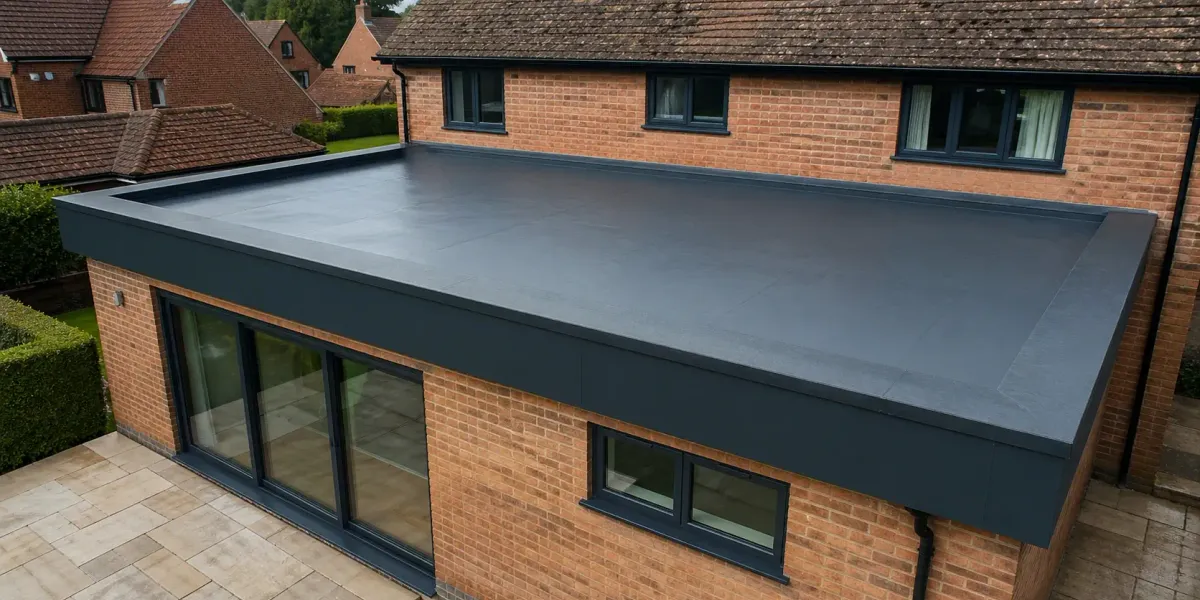
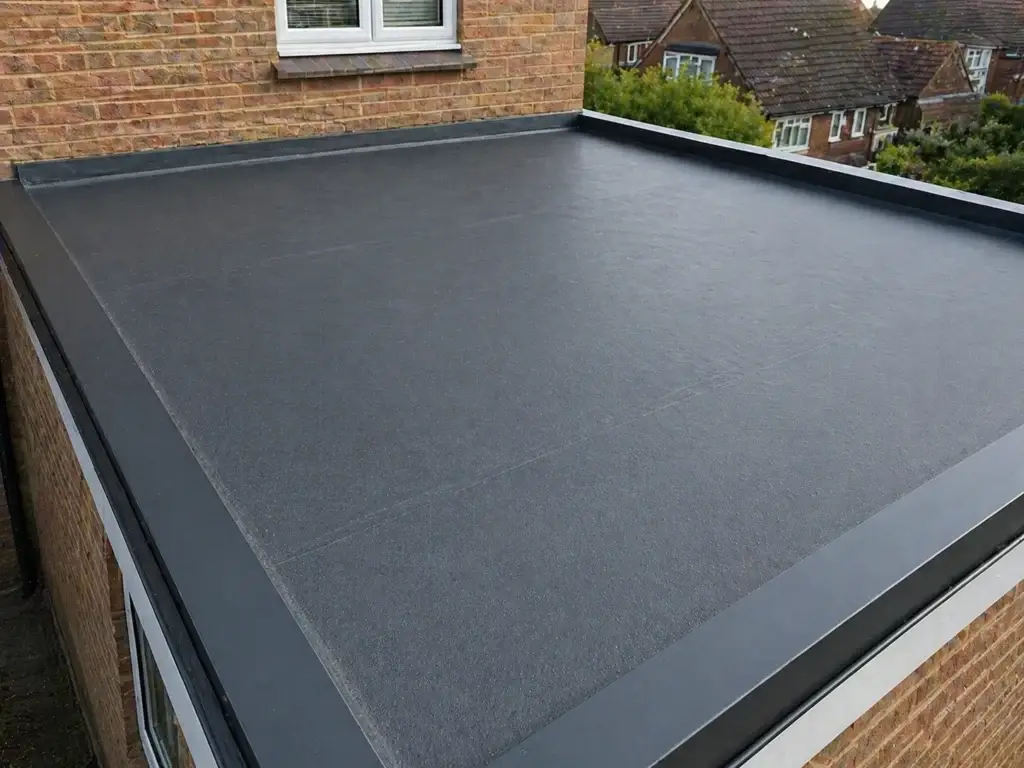
Up Top Roofing’s preferred system for South Coast properties is EPDM rubber, which carries a 50-year minimum lifespan when properly installed. We also fit GRP for complex detailing and torch-on for traditional specs.
There is no single official UK domestic flat-roof price index. The numbers below are planning bands synthesised from current homeowner price guides. Treat them as planning ranges, not quotes.
Repair costs
Simple defect repairs: £60 to £1,000 depending on access, size and material
Average leaking-roof repair call: around £375
Bitumen flat-roof repair: around £120 per m² as a working figure
Roofer day rates: £280 to £360 per day (£35 to £45 per hour)
Replacement costs by system
System
Installed planning band (per m²)
Felt
£60 to £120
Torch-on modified bitumen
£60 to £120
EPDM
£70 to £100
GRP
£90 to £130
Liquid-applied (overlay)
£60 to £80
Single-ply PVC/TPO/FPO
£90 to £150
What homeowners typically spend by roof size
Roof size
Repair spend
Standard replacement
Full strip-replace with deck/insulation
Small (12 m²)
£250 to £900
£900 to £1,500
£2,000 to £3,600
Medium (25 m²)
£600 to £2,000
£1,875 to £3,000
£4,250 to £7,500
Large (50 m²)
£1,500 to £6,000
£3,750 to £6,000
£8,500 to £15,000
The trap homeowners fall into
Confusing “new waterproof layer” pricing with “full strip-and-replace” pricing.
Once you add rotten timber replacement, new deck, insulation upgrade, fascias or guttering, totals step up hard. A felt benchmark for a full replacement including deck and joists is around £200 per m². With fascias and guttering it rises to roughly £300 per m².
A cheap quote that excludes deck repairs becomes an expensive quote on day two when the strip-off reveals soft timber.
How to inspect your flat roof safely
Do not climb on the roof. HSE rules treat all roofs as fragile until a competent person says otherwise. A leak is not worth a fall.
Inspect from inside the property and from a safe vantage point (ground level, an upper window, photos or video).
Inside the property
Ceiling staining or watermarks
Damp smells in upstairs rooms
Mould around corners or skirtings
New bubbling on internal paint
Drips that worsen after wind-driven rain
Outside (from safe distance)
Splits, tears, punctures or cracks in the membrane
Bubbles, blisters or rippling (suggests trapped moisture)
Lifted seams, open laps, defective edge trims
Standing water (chronic ponding, not just rainfall draining)
Blocked outlets, leaf build-up, moss around drains
Sagging, softness or any sign the deck may be wet
Cracks at upstands, parapets, rooflights, pipe penetrations
Age of the system and patch history
Rule of thumb: if you find more than one category of failure, stop thinking “one repair” and start thinking about whether the system is still worth backing.
When to call a professional
Call us straight away if you have:
Active internal leaks
Soft or sagging deck
Multiple failed details
Persistent ponding water
Damage near electrics
Suspicion of asbestos on an older garage or outbuilding
Wet insulation or rotten structural timber
Wet insulation and timber decay are usually invisible until the roof is opened up. Patching over decay is where cheap jobs turn into expensive jobs.
Temporary means temporary. Do not skip a proper repair because the bucket is catching the drips.
Sensible emergency sequence:
Protect the inside. Catch water, move valuables, isolate electrical circuits if water is near them
Photograph everything. You’ll need this for insurance claims
Contact your insurer quickly if storm-related or potentially claimable
Book a roofing inspection the same day where possible
Use temporary patching only if it can be done safely without exposing anyone to a fall
The Association of British Insurers advises contacting your insurer as soon as reasonably possible and only carrying out temporary repairs to prevent further damage if it is safe and after speaking with them.
Do not climb on the roof to fix it yourself. A leak is not worth a fall.
Building Regulations, warranties and insurance
Building Regulations (England)
Approved Document L applies to renovated thermal elements. For existing dwellings, the renovated roof U-value target is 0.16 W/m²K where renovation affects more than 50% of the element’s surface area.
In Wales, repairing or re-covering less than 25% of a flat roof typically does not need a building regulations application, but replacing a roof with integral insulation can still trigger thermal-upgrade requirements.
Scotland and Northern Ireland run their own building standards systems. Always check local rules before work starts.
The current technical codes are BS 6229:2025 (flat roofs) and BS 5250:2021 (moisture management). Industry guidance derived from BS 6229 specifies that finished falls should normally achieve 1:80, with design allowance often at 1:40 to account for tolerances and deflection.
Manufacturer-backed product or system guarantee (varies, often 20-50 years)
Insurance-backed guarantee (IBG) (covers you if the contractor goes under)
The NFRC explicitly recommends an insurance-backed guarantee on new or refurbishment work. Up Top Roofing provides a 10 Year Insurance Backed Guarantee on all flat roofing installations as standard.
Insurance: where homeowners get caught out
Buildings insurance usually covers the structure against insured events such as storms. Both insurer and trade-body guidance make clear that general wear and tear and lack of maintenance are usually not covered.
If a storm exposes a roof that had already been allowed to deteriorate, expect a tougher claim conversation than you anticipated.
Repair is usually better when the problem is isolated and the rest of the roof is still sound. Replacement is usually better when leaks keep coming back, the roof is near end of service life, insulation is wet, or drainage and detailing are failing across multiple areas.
How long should a flat roof last in the UK?
It depends on the system. Basic felt typically lasts 10 to 15 years. Modern torch-on, GRP, EPDM and single-ply systems can last 25 to 50+ years when correctly specified, installed and maintained.
How much does flat roof replacement cost in the UK in 2026?
Standard flat roof replacement currently averages around £75 per square metre, with totals varying depending on size, access, material, insulation, detailing and whether the deck also needs replacing. A medium 25 m² roof typically costs £1,875 to £3,000 for a standard replacement, or £4,250 to £7,500 for a full strip and rebuild.
For wider roof replacement projects involving Building Regulations, insulation upgrades or a full strip-and-replace, our UK roof replacement guide explains what homeowners need to know before starting work.
Does a leaking flat roof always mean full replacement?
No. A small puncture, local split, isolated flashing failure or one defective detail can often be repaired successfully. The key question is whether the leak is local or a symptom of a wider system failure.
Do I need building control approval to replace a flat roof?
Sometimes. Larger roof renovation works can trigger thermal-upgrade requirements or other building control issues. The exact requirement depends on the scope of work and the country where the property sits.
Will home insurance pay for flat roof repair or replacement?
Insurance may cover storm-related or sudden insured damage to the structure, but general wear and tear and damage caused by lack of maintenance are typically excluded. Always check your policy wording and notify the insurer quickly if you may need to claim.
Which is better: EPDM, GRP or felt?
For most South Coast homes, EPDM offers the best balance of lifespan (50+ years), weather resistance and value. GRP wins on complex detailing. Felt remains the cheapest upfront but has the shortest service life.
Ready for a straight answer on your flat roof?
If your flat roof is leaking, ponding or just past its best, the next step is an inspection, not guesswork.
Book an inspection with Up Top Roofing and get a practical recommendation, not a sales pitch:
If a targeted repair is enough, we’ll say so
If replacement will save money long-term, we’ll show you why
Written quote with everything itemised
10 Year Insurance Backed Guarantee on every new flat roof
In-house scaffolding (no third-party delays)
30+ years serving Dorset, Bournemouth, Poole and Christchurch
Award-winning, 5-star rated
Call now for a free quote or use our callback form for a fast response in office hours.